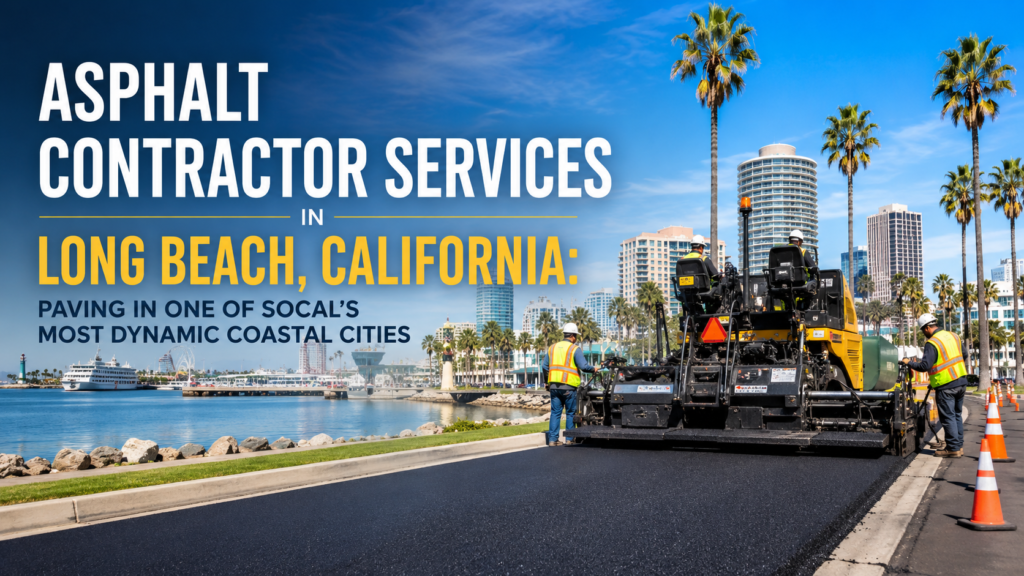
Long Beach, California is one of the most distinctive cities in the Los Angeles basin a major port city, home to the Port of Long Beach (the busiest container port in the United States), the site of California State University Long Beach and Long Beach City College, and a city whose neighborhoods range from the upscale waterfront homes of Belmont Shore and Naples Island to the dense urban fabric of downtown and the residential communities that spread eastward toward Signal Hill and Los Alamitos. With a population exceeding 460,000, Long Beach generates substantial and diverse demand for asphalt paving services from residential driveways in its established neighborhoods to the extensive parking infrastructure of its commercial corridors, educational campuses, and industrial areas near the port. Understanding what Asphalt Contractors Long Beach, how the city’s coastal climate affects pavement, and what quality work requires in this environment gives property owners the context to make informed paving decisions.
The Scope of Asphalt Contractor Services in Long Beach
A full-service asphalt contractor in Long Beach provides an extensive range of paving services covering both new construction and ongoing maintenance:
- Residential driveway installation and replacement: Building new asphalt driveways on previously unpaved surfaces, or removing and replacing driveways that have reached or exceeded their service life.
- Asphalt resurfacing and overlay: Applying a new asphalt surface course over an existing structurally sound base, extending pavement life without the cost and disruption of full replacement.
- Parking lot construction and maintenance: Designing, building, and maintaining the asphalt parking infrastructure that serves Long Beach’s many commercial, institutional, and industrial properties.
- Crack filling and sealing: Applying flexible sealant to surface cracks to prevent water infiltration and extend pavement life.
- Sealcoating: Applying a protective emulsion coating to shield asphalt from UV oxidation, salt air, and moisture.
- Asphalt milling: Using cold planing equipment to remove the existing asphalt surface layer to a specified depth before overlay, maintaining proper elevation at curbs, inlets, and adjacent surfaces.
- Pothole repair and patching: Restoring areas of localized pavement failure using infrared or traditional remove-and-replace techniques.
- ADA compliance improvements: Ensuring that accessible parking spaces, ramps, and pedestrian routes meet California Title 24 and ADA requirements.
- Parking lot striping and marking: Applying traffic-grade line markings for spaces, fire lanes, accessible spaces, and traffic flow designations.
Long Beach’s Coastal Climate and Asphalt Performance
Long Beach’s climate a Southern California coastal Mediterranean climate creates a specific asphalt aging environment that differs from both inland cities and colder regions. The city sits just south of the Los Angeles Harbor, directly on the Pacific coast, and experiences daily marine layer conditions during the late spring and summer months (“June Gloom”). Key climate factors affecting asphalt in Long Beach:
- Salt air exposure: Long Beach’s proximity to the Pacific and the active port environment means that salt aerosols are continuously deposited on all surfaces, including paved ones. Salt air accelerates asphalt binder oxidation and can affect the metal hardware in drainage infrastructure. This makes sealcoating the primary defense against binder oxidation particularly important in Long Beach compared to inland California cities.
- UV radiation: Despite the morning marine layer, Long Beach receives intense UV radiation during afternoon hours that contributes to asphalt oxidation. The binder that gives asphalt its flexibility gradually hardens under UV exposure, causing the surface to become brittle and develop surface cracking. Without sealcoating, Long Beach asphalt surfaces typically begin showing visible gray oxidation and cracking within three to five years of installation.
- Marine layer moisture: The daily condensation from morning marine layer contributes moisture to pavement surfaces and can infiltrate existing cracks. Over time, this moisture cycling contributes to binder degradation and accelerates deterioration of already-cracked surfaces.
- Moderate temperatures: Long Beach’s coastal climate moderates temperature extremes. Summer highs rarely exceed the mid-80s along the coast, and winter temperatures almost never reach freezing. This means Long Beach asphalt does not experience the freeze-thaw damage that is the primary deterioration mechanism in colder climates. The absence of freeze-thaw somewhat extends service life relative to northern markets.
The Port of Long Beach and Industrial Asphalt Demands
Long Beach’s position as home to the nation’s busiest container port creates an industrial paving environment unlike anything found in most California cities. The terminal facilities, logistics parks, distribution centers, and industrial corridors near the port require asphalt and pavement systems designed for dramatically heavier loads than standard residential or commercial applications.
Container handling equipment rubber-tired gantry cranes, straddle carriers, terminal tractors, and loaded container chassis exerts loads on pavement that far exceed what standard asphalt specifications can support. Industrial paving near the Port of Long Beach uses much thicker asphalt sections, higher-strength aggregate bases, and sometimes full-depth asphalt construction without aggregate base to achieve the load-carrying capacity these operations require. Asphalt contractors serving the port industrial area possess the technical knowledge and equipment to work at this scale and specification.
Residential Asphalt Paving in Long Beach Neighborhoods
Long Beach’s residential fabric spans a wide range of neighborhood types and property ages. Belmont Shore, Naples Island, Bixby Knolls, Los Altos, and Wrigley are just a few of the distinct neighborhoods that make up the city’s residential landscape. Many Long Beach homes were built during the postwar suburban expansion of the 1940s through 1960s, meaning that driveways on these properties even if replaced once since the home was built may be reaching or past the end of their second service life.
Key considerations for residential asphalt paving in Long Beach include:
- Base condition assessment: In Long Beach’s coastal climate, the absence of freeze-thaw damage means that base layers under existing driveways can remain structurally sound for decades even when the surface has visibly aged. Many Long Beach driveways that look terrible on the surface are actually good candidates for overlay (resurfacing) rather than full replacement. An honest base assessment before committing to a project approach saves property owners money.
- Drainage design: Long Beach’s relatively flat terrain particularly in the areas west of Signal Hill requires attention to driveway drainage slope. Water that pools on or near a driveway infiltrates cracks, contributes to binder degradation, and can stain or damage adjacent structures. Proper grade design ensures water moves off the surface to the street or appropriate drainage outlet.
- CSLB licensing: California requires that any contractor performing work valued at $500 or more hold a current California Contractors State License Board (CSLB) license. For asphalt work, the C-12 (Earthwork and Paving) classification is the applicable license category. Long Beach property owners should verify current CSLB license status before engaging any paving contractor.
Commercial Asphalt in Long Beach’s Business Districts
Long Beach’s commercial paving market is driven by its diverse commercial character. The Pine Avenue and East Village downtown corridor, the Long Beach Towne Center and Airport-area retail and office developments, the healthcare campuses associated with Long Beach Medical Center and other facilities, the educational infrastructure of CSULB and Long Beach City College, and the industrial and logistics properties near the port all generate significant and varied commercial paving demand.
Commercial parking lot maintenance in Long Beach follows the same fundamental cycle as in other Southern California markets: annual inspection, crack sealing every one to two years, sealcoating every two to three years, overlay resurfacing every twelve to twenty years depending on traffic and maintenance history, and ADA compliance review with any significant paving work. The coastal climate’s UV intensity and salt air make consistent sealcoating particularly important for maintaining commercial pavement in serviceable condition throughout this cycle.
City of Long Beach Permit Requirements
Most standard residential driveway replacements within the existing footprint in Long Beach do not require a building permit. However, modifications to curb cuts or driveway approaches the transition between the private driveway and the public street do require an encroachment permit from the City of Long Beach Public Works Department. Any work within the public right-of-way, including the parkway, sidewalk, and curb zones adjacent to private property, requires this permit. For commercial paving projects involving drainage modifications, parking configuration changes, or other site improvements, additional permits from the City’s Development Services Department may apply.
Conclusion
Asphalt contractor services in Long Beach address the paving needs of one of Southern California’s most diverse and economically active cities from residential driveways in historic beach neighborhoods to the industrial-grade pavement infrastructure of the nation’s busiest port. The coastal climate’s combination of UV intensity, salt air, and daily marine moisture creates specific maintenance requirements, with regular sealcoating being the single most impactful practice for extending asphalt service life in this environment. Long Beach property owners and facility managers who understand these factors, verify CSLB contractor licensing, and commit to proactive maintenance schedules protect their paving investments effectively.